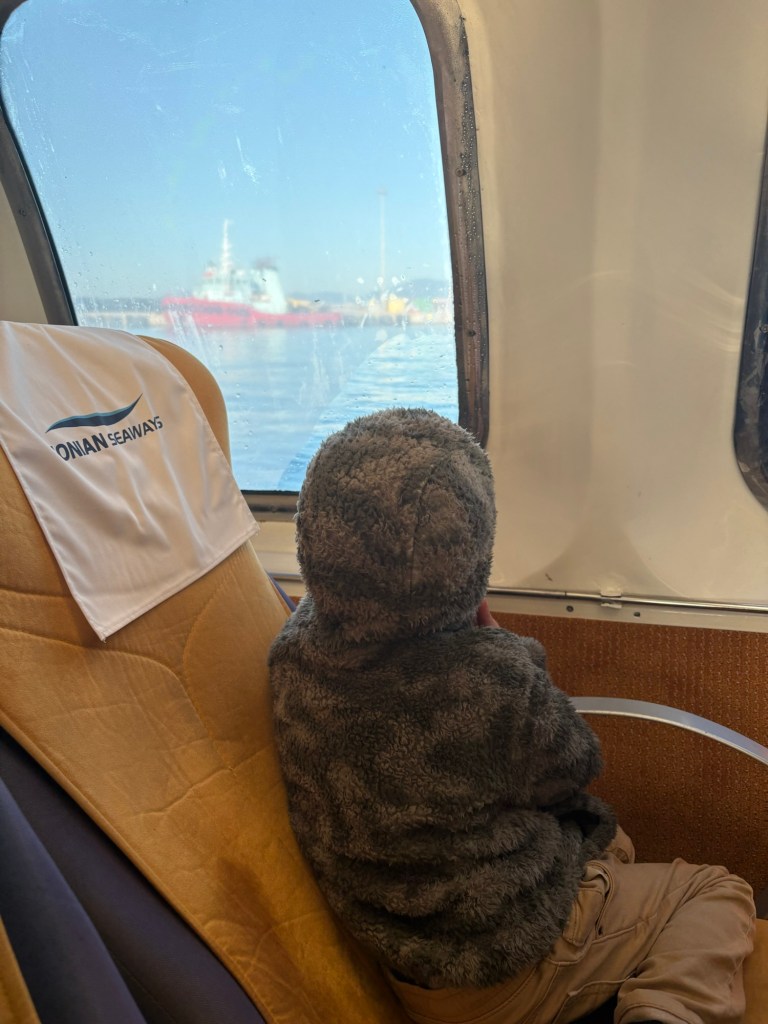
I first learned about the Greek island of Corfu when I watched The Durrells a few years ago. (Check it out if you appreciate Greek island scenery and British humor.) Nic and I watched the show together recently, and so we simply had to visit. Thirty minutes on a ferry transports you from Sarandë to Corfu, or as our Airbnb host in Corfu compared the two, “From Miami to Mexico – no, farther down – to Chile.” Although only a small stretch of water separates the two cities, they feel quite different. But you can’t flush toilet paper in Corfu either, we were disappointed to discover.
Since ferries only run once a day at this time of the year we had to stay a night in Corfu. With what we have booked so far for January and February, we had almost used up our permitted ninety days without a visa in the Schengen countries. Our Corfu trip brought us to exactly ninety days.
Gyros – yum!
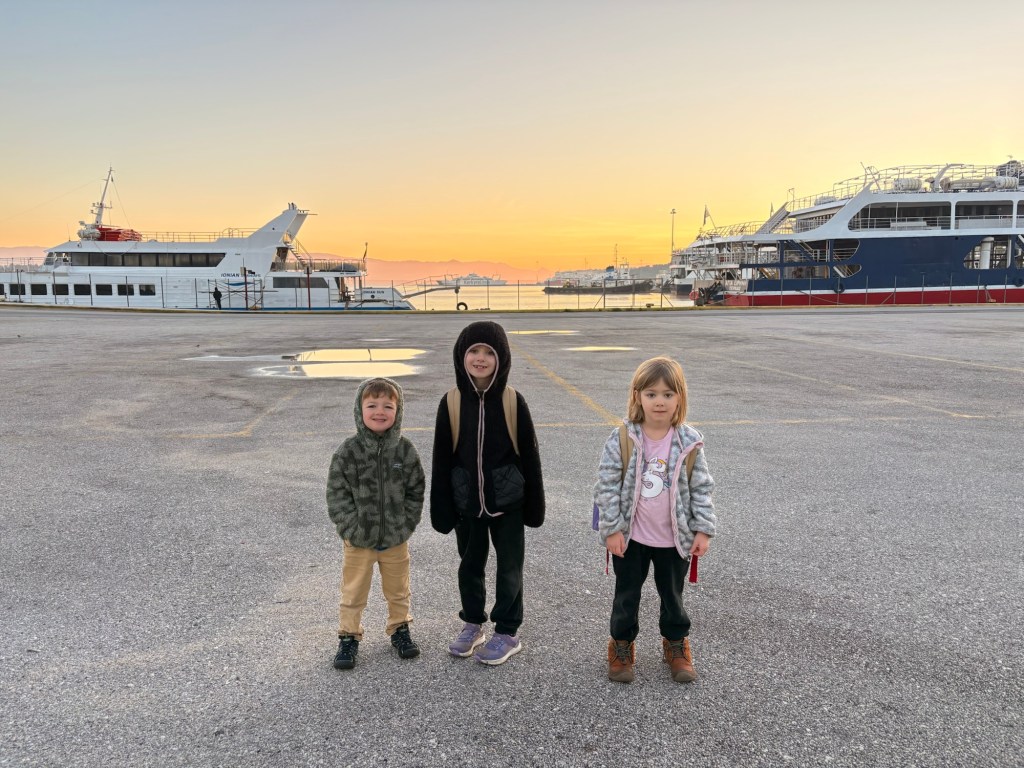
In our short time on the island we ate some delicious Greek food, wandered Old Town, watched the constant coming and going of ships, and enjoyed drinking tap water for the first time in four weeks.
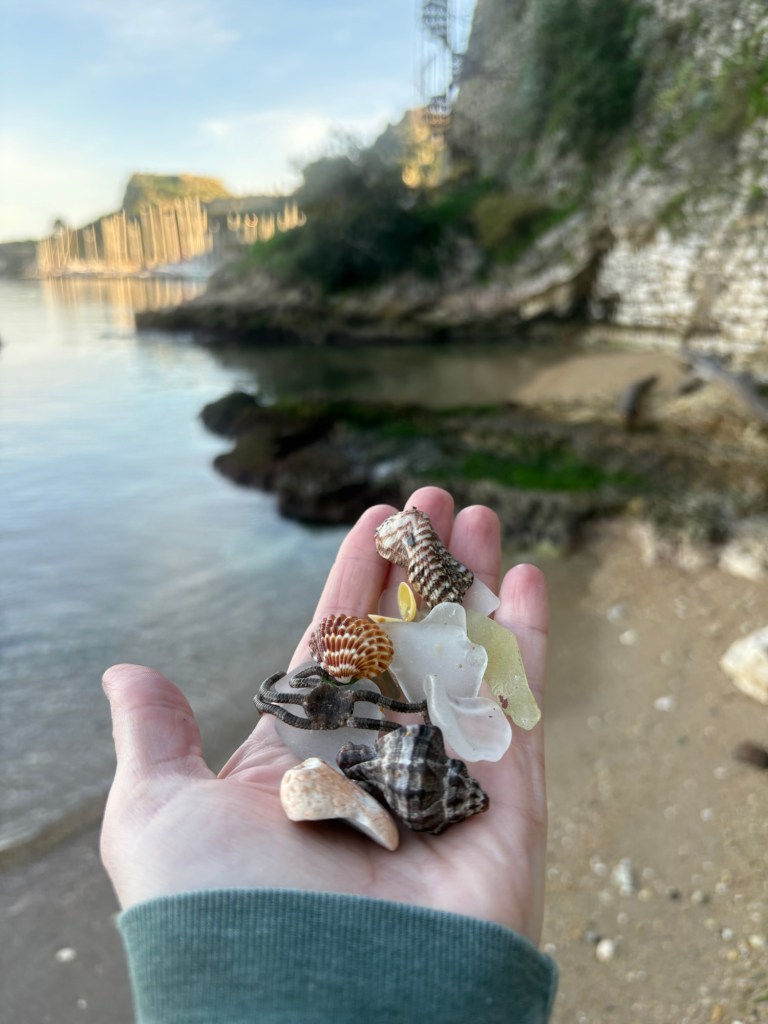
Charming streets with little trash in sightFaliraki BeachA little beachcombing
Everyone we interacted with seemed genuinely friendly and kind (minus the Albanian ladies trying to cut in front of us at passport control). We definitely want to come back to Greece someday and swim in that beautiful water!
Heading back to the ferryMorgan choosing his favorite tugboat
Speaking of cutting in line, we have wondered many times why it’s acceptable to cut in line here. We’ve often had people step right in front of us when we’re obviously in line. It happens constantly when driving too. And if you actually want to keep your spot in line, you have to basically stand on top of the person in front of you and ignore the people trying to cut as you keeping moving forward. There is no extra consideration for a family with young children either. Of all the customs that are different here, like walking across the street without looking at traffic or some of the driving habits, we just can’t figure out why a skill you learn on the playground as a toddler doesn’t apply.
I am happy to say we have improved our vomit odds with adding only one barf day in the last five. That brings us to nine out of twenty-eight days. We’ve tightened controls around fresh produce, restaurant food, and toothbrushing water, which has perhaps helped make a difference.
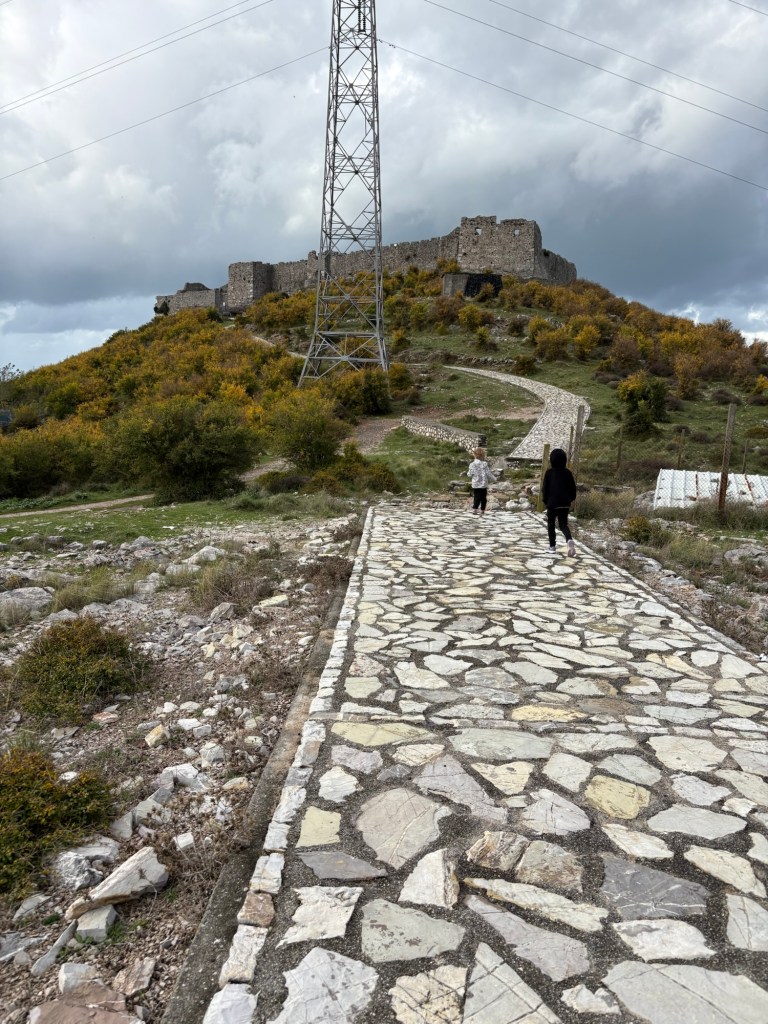
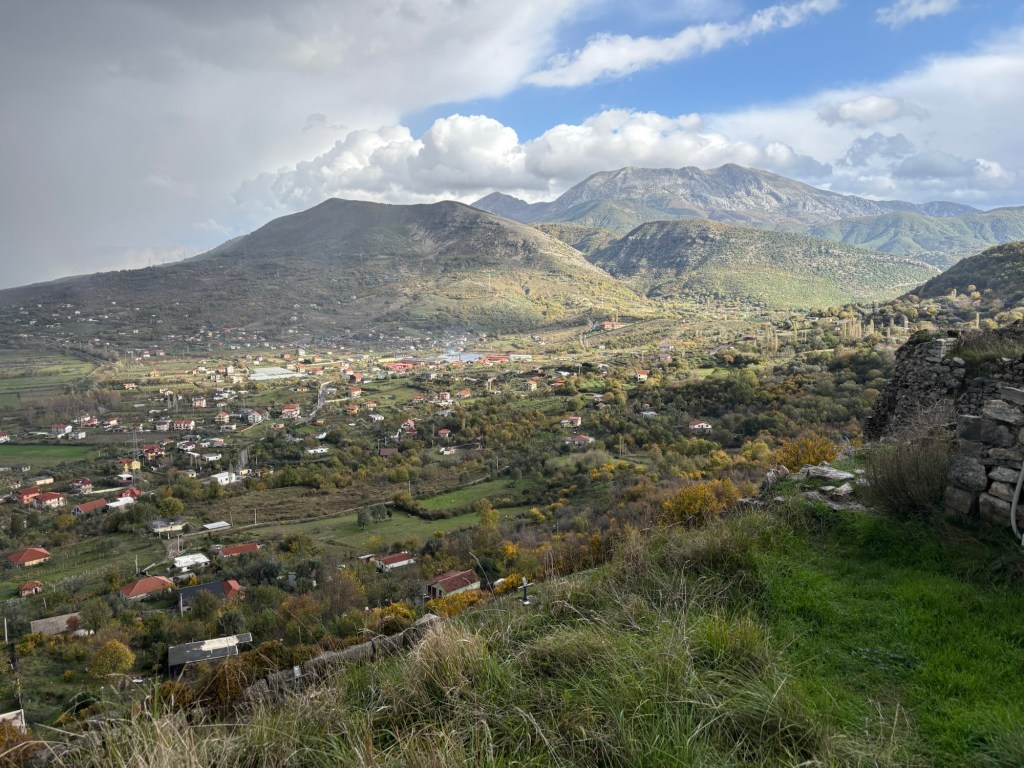
Meanwhile, we’ve been busy touring southern Albania. We took a morning detour while heading toward the coast to stop at Gjirokastër. We walked up steep cobblestones into the clouds to get to the castle. Some form of fortress has stood here since the 12th century, and the whole family enjoyed exploring our lofty perch. The clouds cleared enough to see the maze of whitewashed buildings and streets materialize beneath us.
Gjirokastër FortressGjirokastër
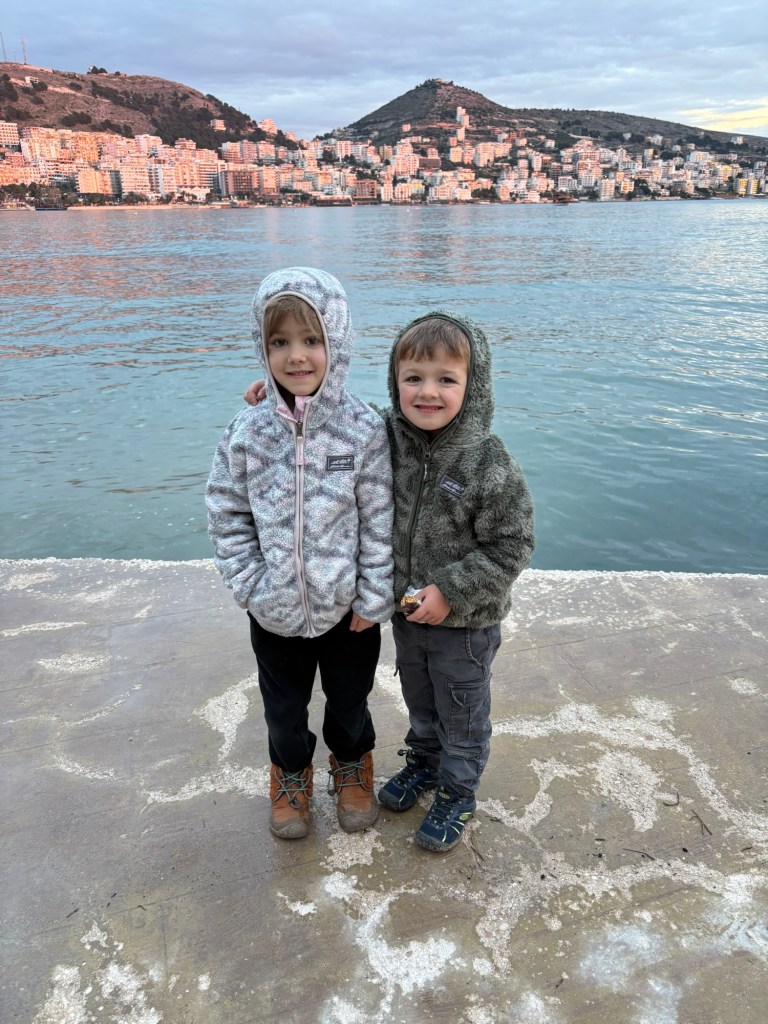
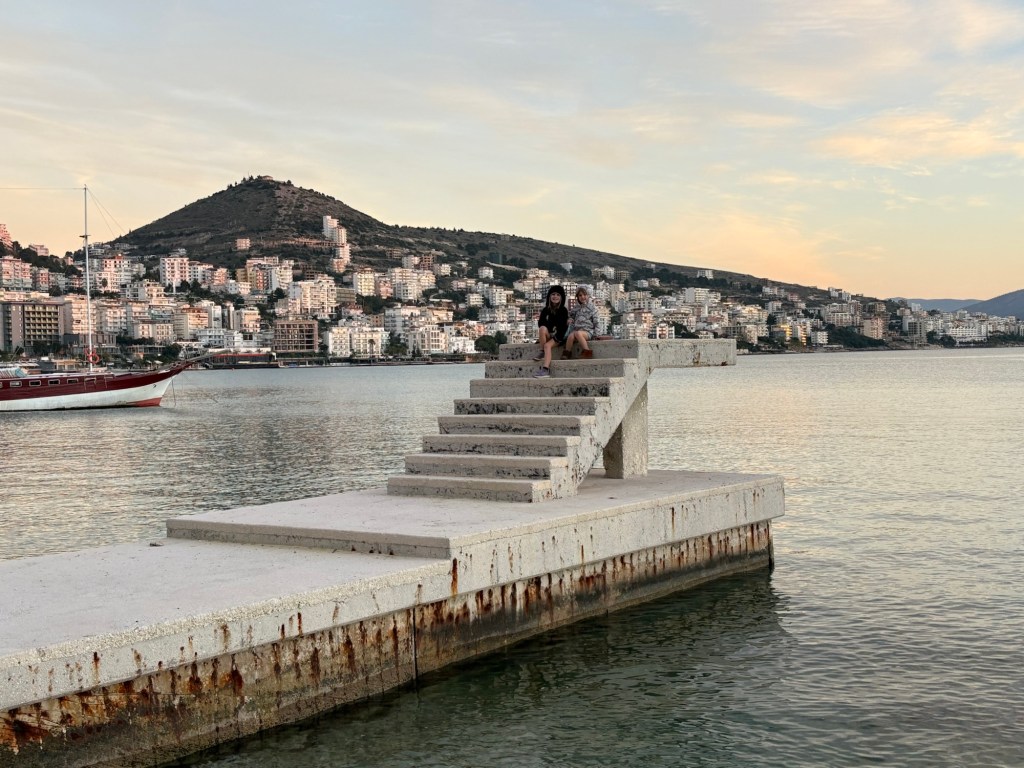
We continued to the coast and Sarandë. Nic navigated the packed streets, and we lucked out and found a really good parking spot. For the most part we’ve enjoyed Sarandë. It feels a bit fancier than anywhere else we’ve been so far in Albania with many stores that wouldn’t be terribly out of place in Italy. We still see trash and stray animals everywhere, but the beach promenade is beautiful, and the weather has been absolutely perfect. The kids have found loads of sea glass on the pebble beaches, and we’ve tried to beach comb a bit every day as time has allowed.
The Twiddles, as we call our middle kids
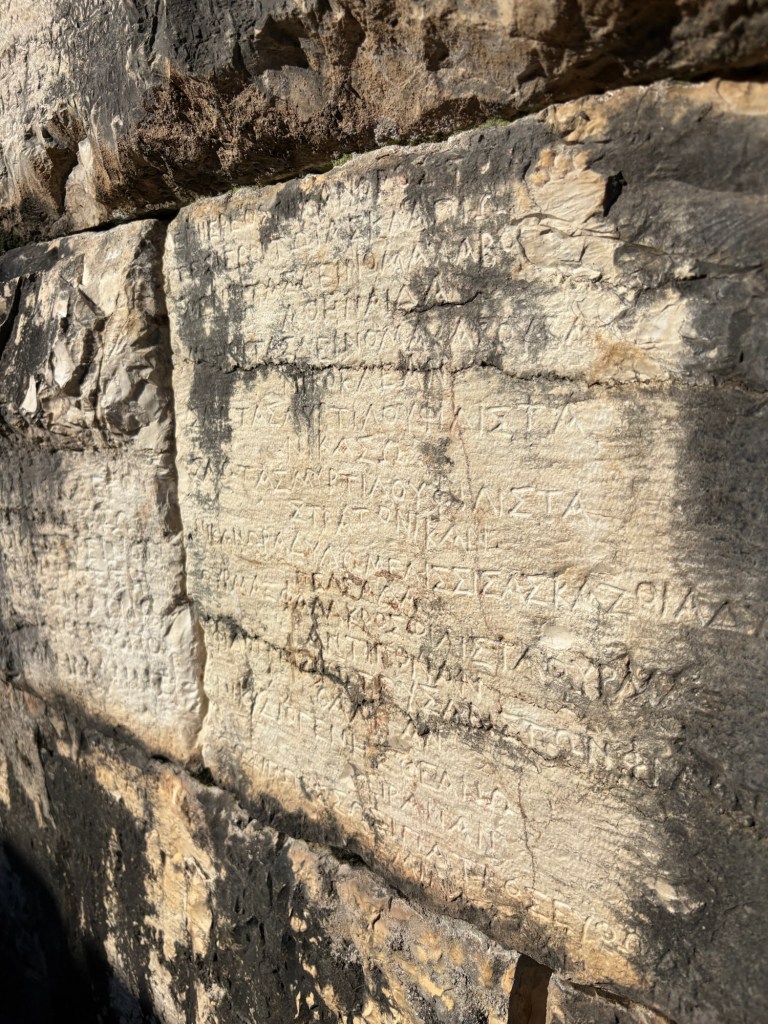
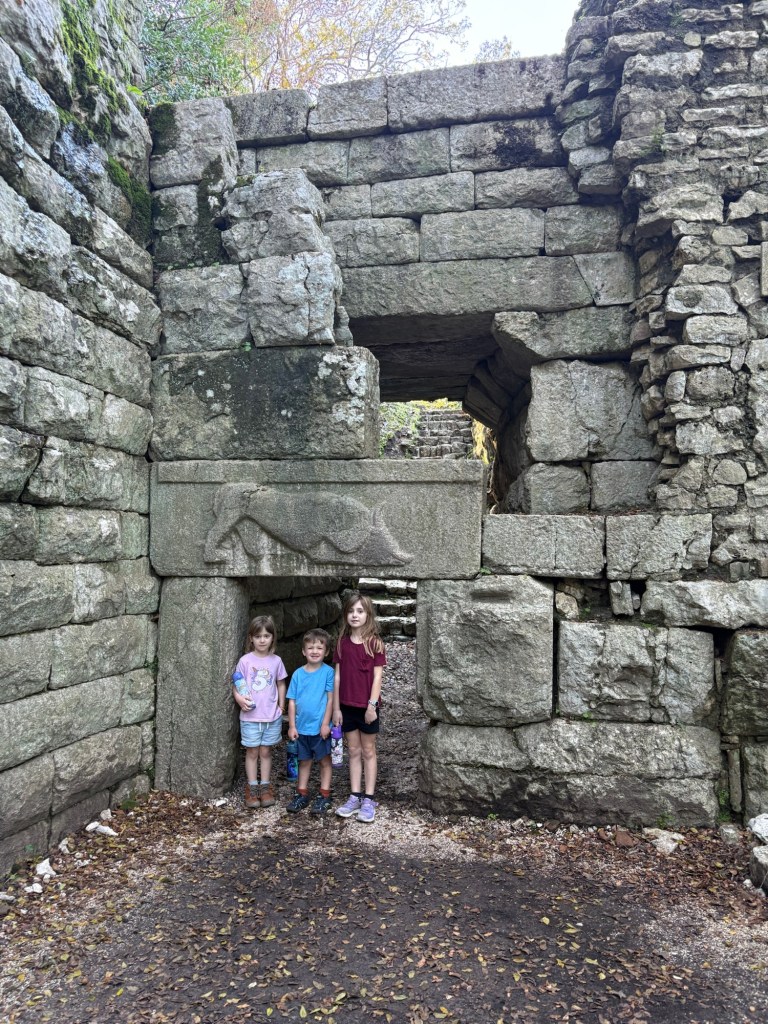
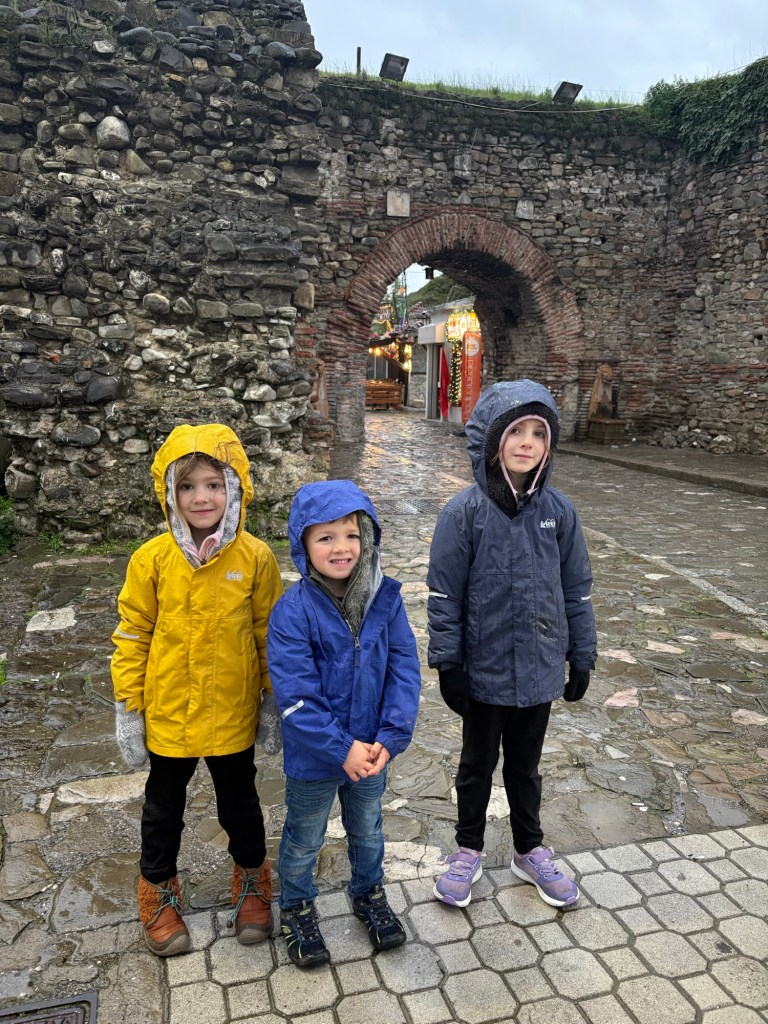
We sacrificed our perfect parking spot to visit Butrint, a fascinating piece of history just half an hour south of Sarandë. This piece of Albania had been fought over and ruled by just about everyone who has ever controlled parts of Albania: Greeks, Romans, Venetians, Ottomans, and more. You see huge pieces of this history at Butrint National Archaeology Park. We wandered through a Greek theater built in the 4th century BC, which is the oldest bit of history we’ve ever seen. We also saw Roman, Byzantine, and Venetian ruins – all for about $20!
Greek theater from the 4th century BCSee the inscriptions?A Roman gateThe Greek island of Corfu in the background
Albania has a number of ancient ruins, and we have only scratched the surface of the historical treasures on display. Much of the archaeological work at Butrint began a century ago, but some parts have been discovered as recently as the last decade. Works continues each fall on the Acropolis area. We looked at the woods we walked through and wondered what else rests under the trees, waiting patiently to be unearthed in the future.
We felt rejuvenated after a few peaceful days in Korçë, but the drive to Përmet did a number on our positive attitudes. Only 81 miles, the stretch of southwest Albanian road between Korçë and Përmet curves and tilts and winds like no other road we’ve traveled. Words cannot properly explain the insane degree of curves. We passed through beautiful countryside with snowy mountain peaks and scenic rural villages clinging to the hills, but it’s hard to enjoy the view when you’re worried about your kids getting ill. After a substantial number of hairpins (and very slow speeds averaging 20 mph at best), Laila succumbed to a bad case of carsickness. Fortunately, she drastically improved her lifelong (poor) odds at successfully directly vomit into an appropriate container.
The curves in a particularly bad stretch of less than 2 miles of our route
And returning to the topic of vomit made me wonder: how many days of our total time in Albania have included vomit? Any guesses out there?
After settling into Përmet a bit and adjusting to the chill in our Airbnb, our state of mind improved. We are staying in the bottom floor of our hostess’s house. She offers breakfast and dinner for an additional charge, and in this small mountain town with pretty limited grocery options, we ordered breakfast and dinner twice each. Our hostess welcomed us with a plate of fresh citrus fruit (found in most yards here) and a jar of the local treat gliko, candied and preserved fruit. She cooked (or more likely deep-fried) Albanian pancakes and sausage for our breakfast, with sides of spreadable cheese, shelf-stable milk, bread, and homemade jam. For dinner we first had meatballs and potato fries with a salad of tomato, onion, pepper, and olives, complete with a bottle of homegrown red wine. You see grapevines in many yards here, often covering the patio. For our second dinner, she prepared meat-filled byrek, a savory Albanian pie. We’ve enjoyed her cooking, and it has been nice to get a break from my own uninspired cooking.
Walking around Përmet felt different from other towns. We received more open smiles and loads of the Albanian grandma treatment. Nic even got a big grin and a wave from an older man, which feels like a big accomplishment given the confused stares they typically exhibit. Albanian grandmas will pinch cheeks (pretty hard), kiss cheeks, dole out candy, make it clear they’d like your baby to put on socks or a hat or whatever he needs to appear warmer, and even slap a preschooler’s butt playfully. Ha! Within twenty-four hours our kids received all these types of attention from strangers and were given candy by three separate women.
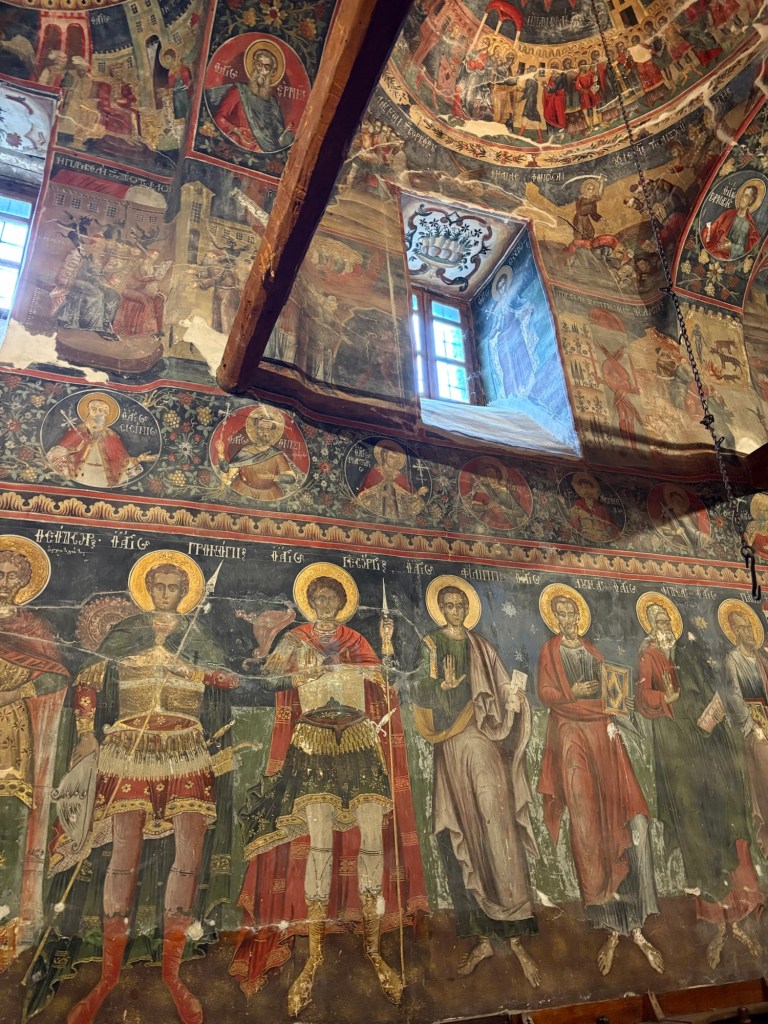
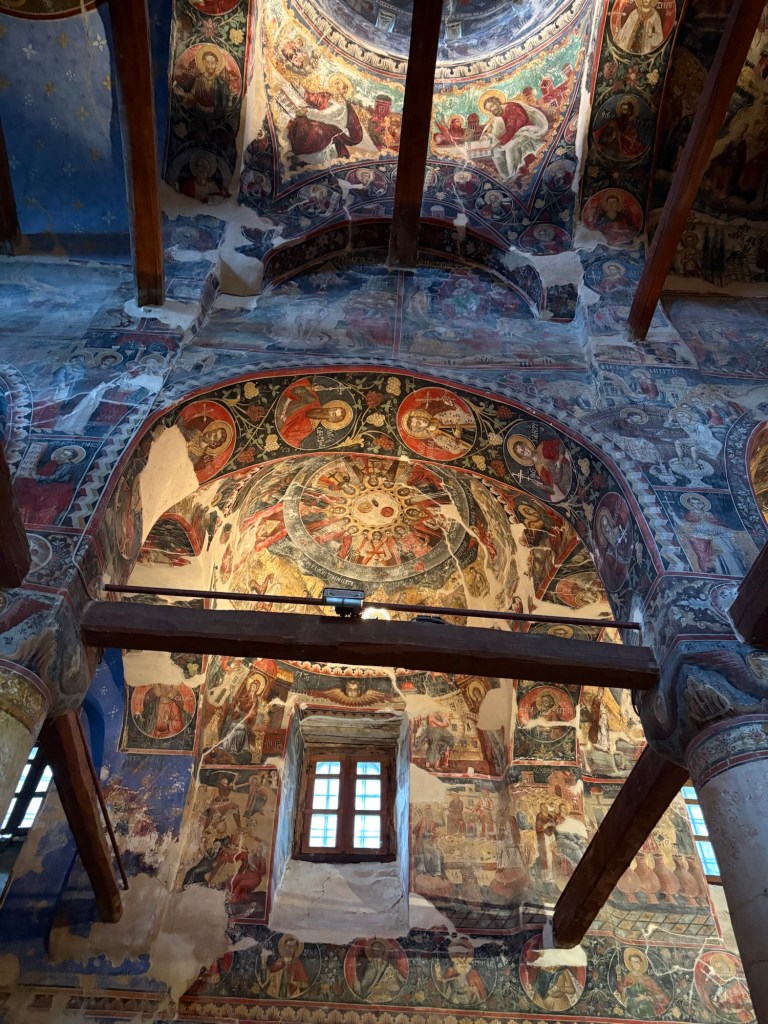
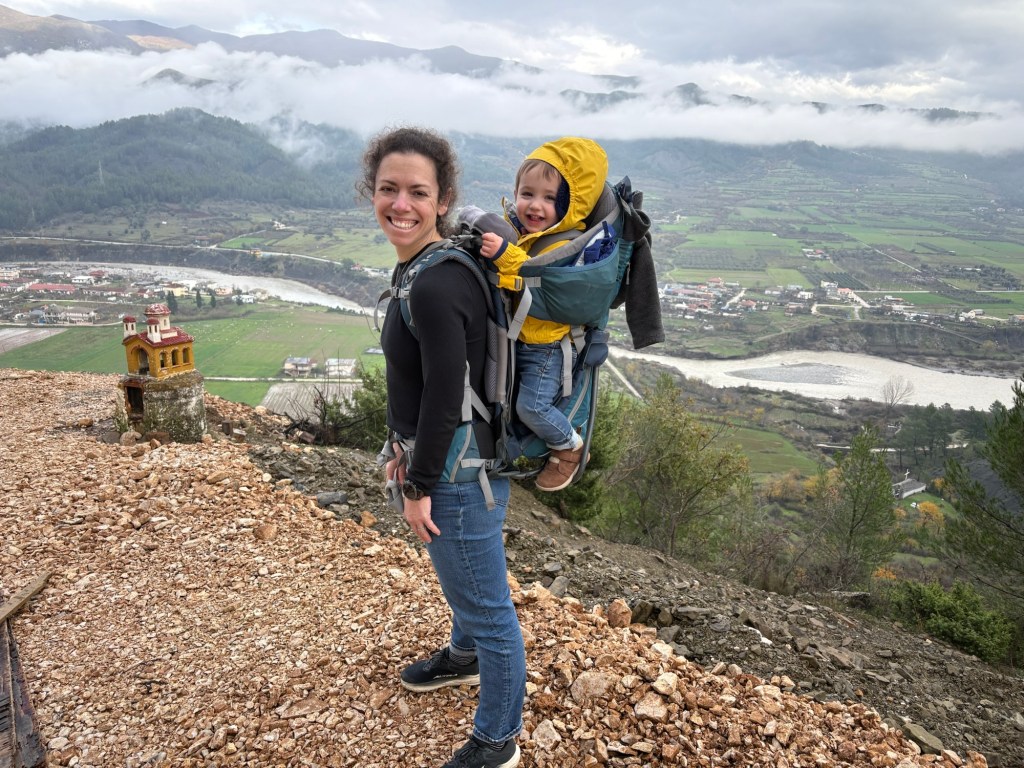
Rain kept us inside chipping away at school for most of our first day here, but the skies cleared enough today for us to adventure a bit. We parked on the edge of town and hiked to the nearby village of Leus. Walking to the village felt like traveling back in time as we saw and heard things like a shepherd with his flock of bell-adorned sheep and goats, ancient stone buildings, an old man riding his donkey home. Low-level clouds hugging the hills added to the atmosphere. We followed instructions to knock at the first house in town to ask to be let into the church, a little stone building from the 1700s with a surprisingly beautiful interior.
Experiences like these remind me of something like walking through the Alpujarra in southern Spain, or some of the little mountain villages I visited in Morocco in college. It hasn’t been entirely easy or pleasant to tour Albania as a family, but being able to do stuff like this together is really special! I think all three big kids have a sense of how unique these experiences are, and they all love to be romping around and exploring outdoors, even when it looks very different from normal.
Church of the Dormition of St. Mary in LeusPërmet in the background
We move on to Sarandë tomorrow. We will have to drive some curvy roads, but they can’t possibly be as wild as what we drove a few days ago. We will spend five nights by the coast before making our way back to the capital for two nights and then flying to Italy.
And in case you wondered, someone in this family has vomited on eight of our twenty-three days in Albania so far. I’d like to remain optimistic and think of the many days most of us have been perfectly healthy, but in reality, I think those odds are lame. I know we can catch norovirus or eat contaminated food or get carsick anywhere, but it will be nice to return to places where we can drink the water straight out of the faucet, flush our toilet paper, and can at least fool ourselves into thinking these issues aren’t going to plague us.
A suspension bridge across the Vjosa RiverThe view atop City Rock in Përmet, a place where they have found fortifications from the 1400s
We have spent a peaceful, restorative handful of days in Korçë. This city of 60,000 feels quiet and urban and much more sophisticated than where we stayed in northern Albania.
We have taken time here to enjoy the fresh mountain air while walking around town. We still attract attention and leave a constant trail of double-takes in our wake, but perhaps we are growing accustomed to it. We have seen only one other foreign family during our five days here.
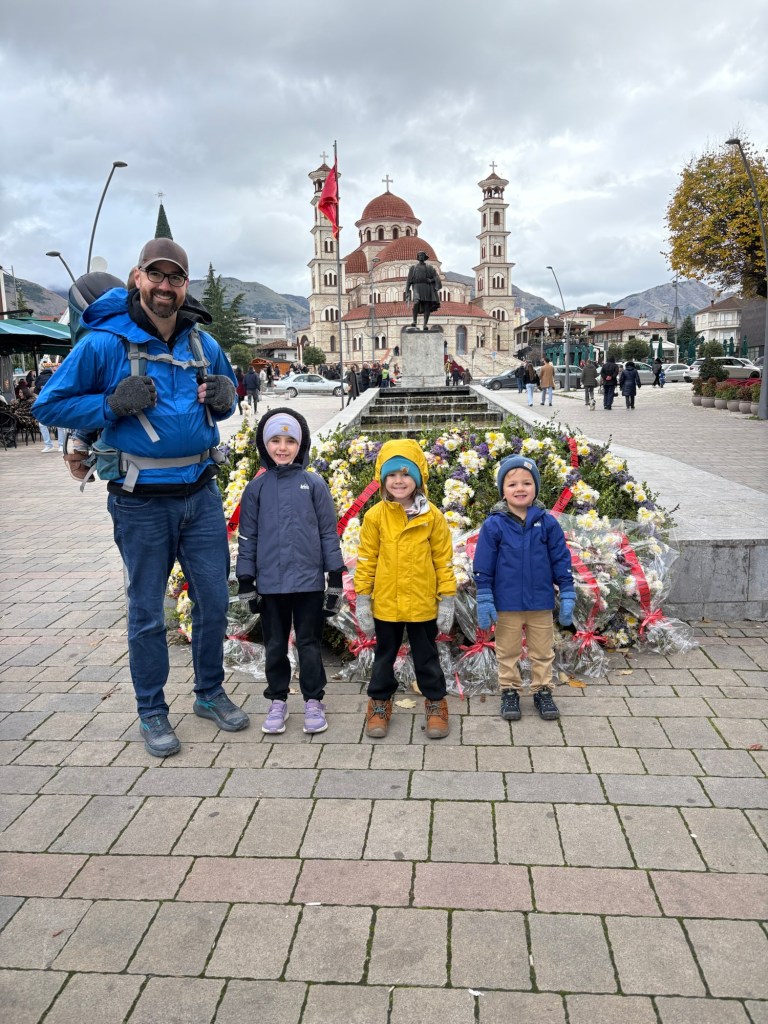
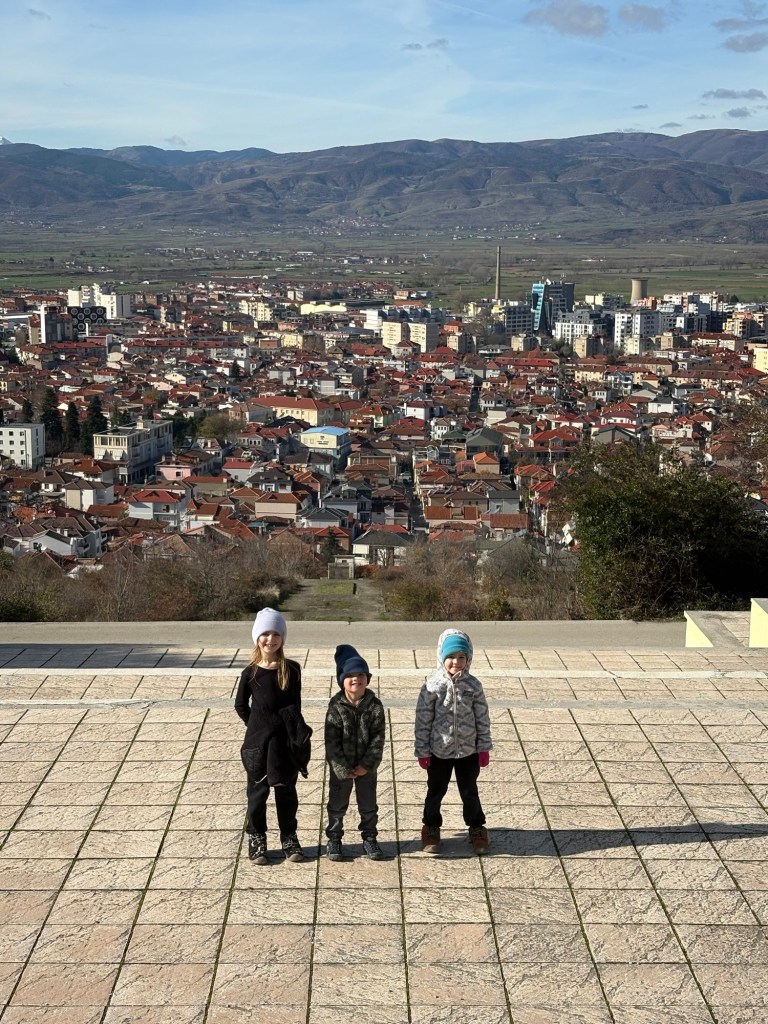
Tomb of the Unknown SoldierLooking down at Korçë
Streets vary between narrow cobblestone streets, leafy pedestrianized boulevards with shiny storefronts, and crowded shopping areas with good displayed outdoors. Around every corner awaits a new quintessentially Albanian view: a few laidback stray dogs, a man driving a little motorized cart yelling to advertise his wares, a crumbling building inhabited only by cats and trash, a car struggling to maneuver through the narrow roads and honking pedestrians onto the tiny curb, an old woman carrying her market purchases home. Yet even with all the life going on in this decent-sized city, peace reigns over all as soon as you get off the main road.
Now that we are all healthy (thank you, Jesus), we have been able to enjoy some local cuisine. We fumbled through the language gap to order lakror, a popular local food consisting of a filling baked between very thin layers of dough. I suppose you could call it a thin type of pie, but it doesn’t compare well to anything I’ve eaten before. We liked the spinach, egg, and cheese filling most. Having figured out what we liked and how to order, we visited the same place twice and got a ton of food for a very low price – yum!
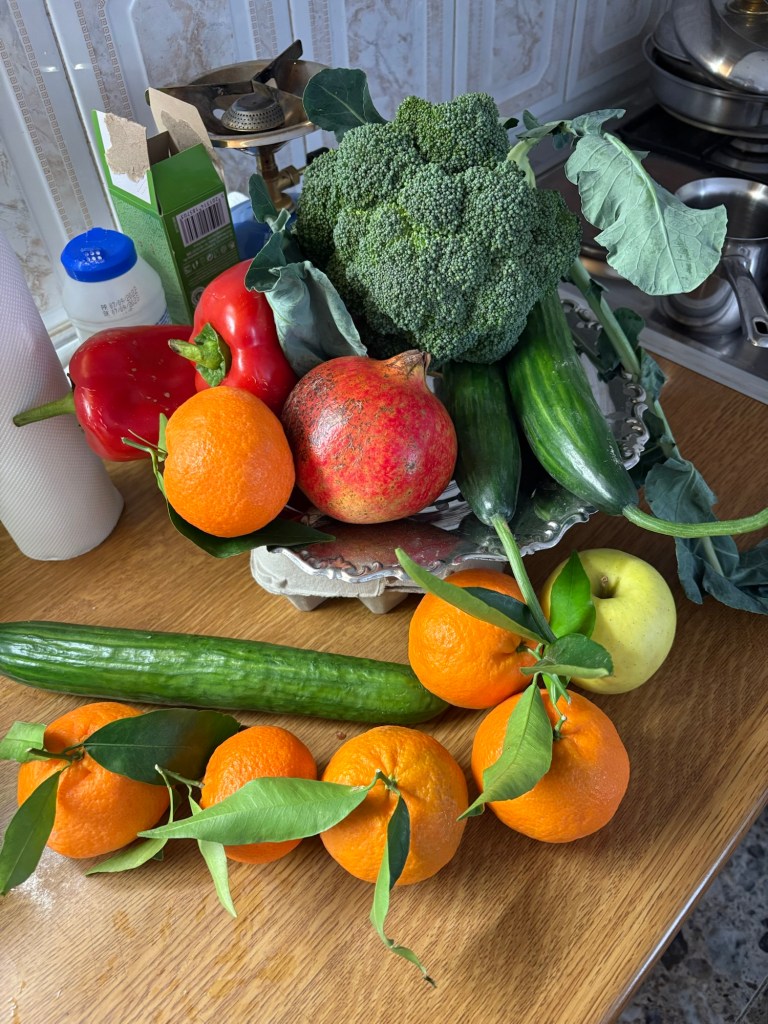
I also finally visited a tiny market to obtain produce. You can find a few pieces of fresh produce in some grocery stores, but most people buy produce straight from the tiny little markets you see literally everywhere. For the equivalent of a few dollars, you can buy amazing oranges, pomegranates, cucumbers, peppers, and much more, just a few minutes’ walk from your doorstep. And if you need a few eggs, packaged snacks, some milk or yogurt, or corn flakes by the kilo, these little markets carry those too. On our third day in a row visiting my favorite market, the shopkeeper was asking the kids’ names in her extremely limited English.
Best oranges everLakror
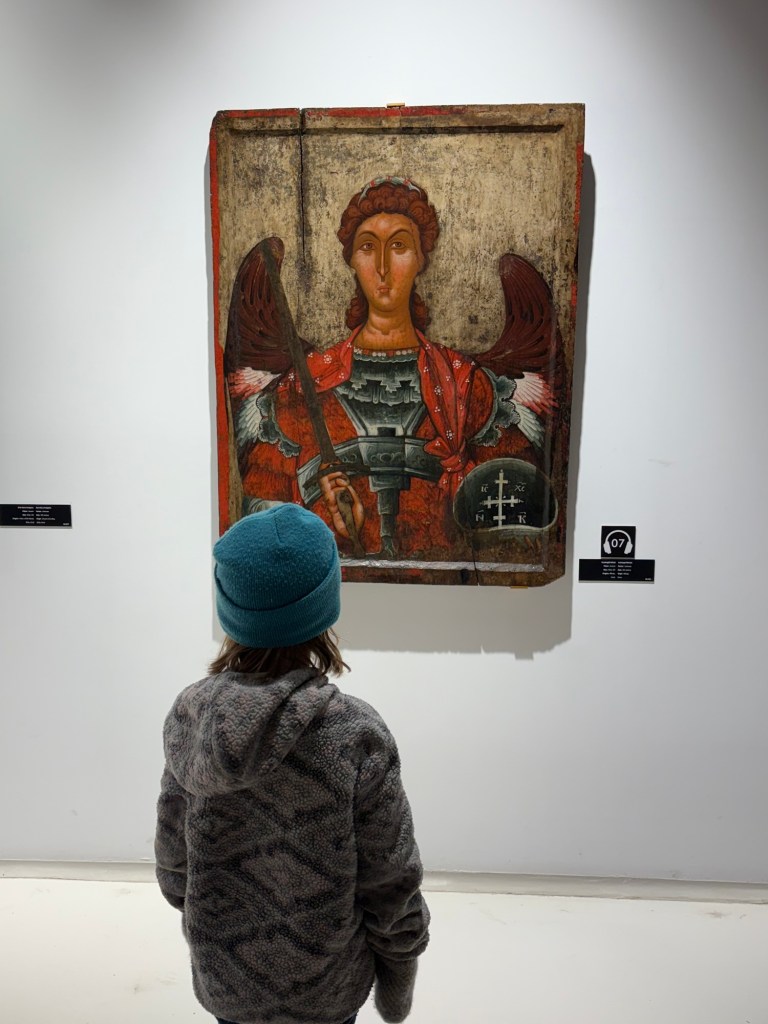
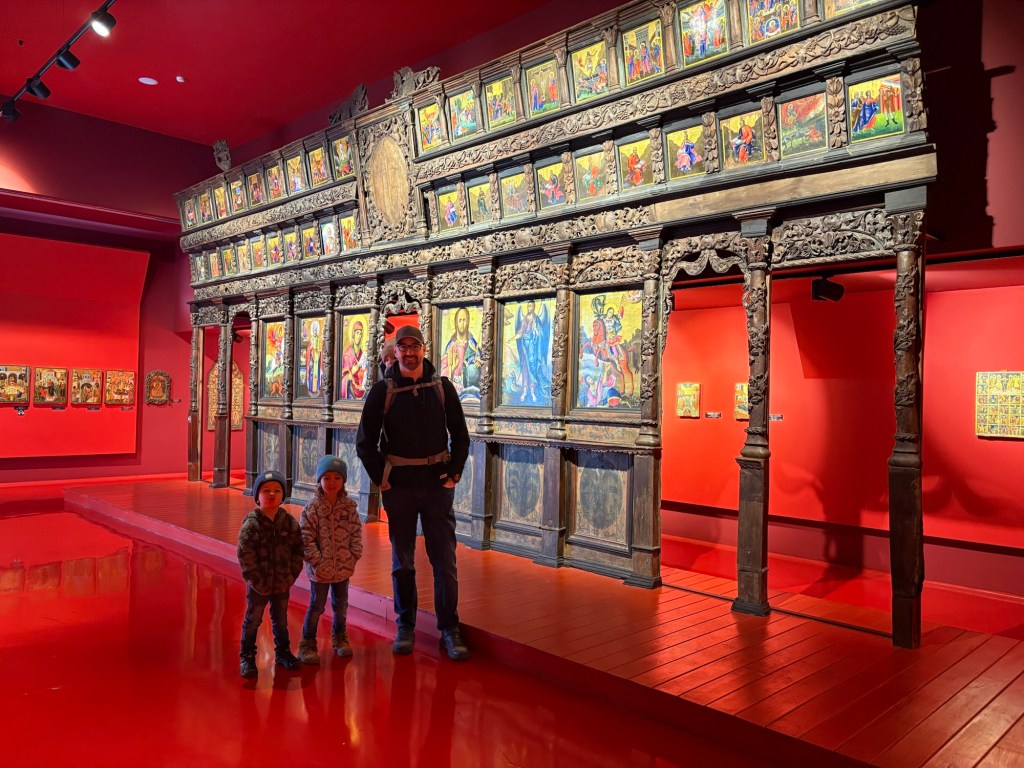
We spent part of a morning at the National Museum of Medieval Art, an important archive of Byzantine and post-Byzantine art from the 13th to 17th centuries. Everyone but Jude enjoyed the vibrant and intricate religious icons. Laila enjoyed pointing out the many versions of John the Baptist’s beheading, and we learned some interesting facts about Orthodox tradition from paintings of saints and things like Mary’s Dormition. These paintings could tell some amazing stories, as many were carefully and cleverly hidden to avoid destruction during Albania’s decades of Communist rule. I guess the Albanians don’t mind visiting cold museums – after about an hour we could feel the cold seeping into our bones.
We move farther south to Permet tomorrow, and we hope to find more fresh-air adventures, good food, and peace!
The whirlwind of sickness seems to have almost completely moved past us. Quinn and I got violently sick with stomach bugs and needed a few days to regain our energy and appetites, especially poor Quinn. Morgan and Jude both experienced a much easier and quicker version of this stomach bug, although Jude continues to have an occasionally unsettled stomach. Nic and Laila must have the best hygiene, as they have remained healthy.
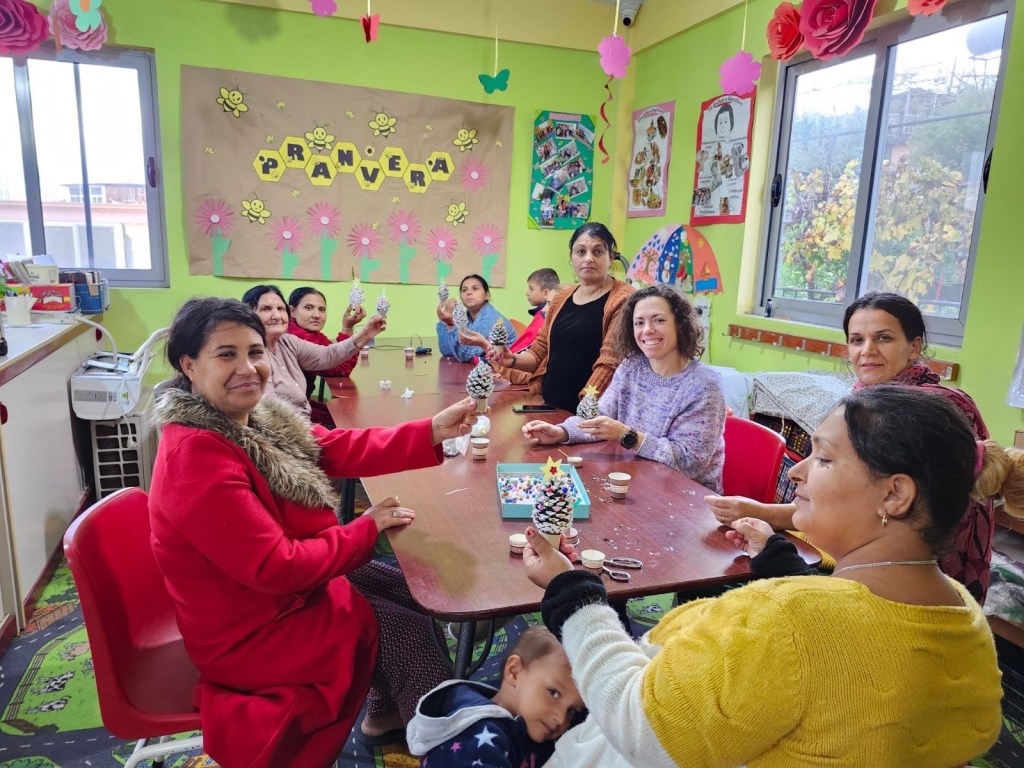
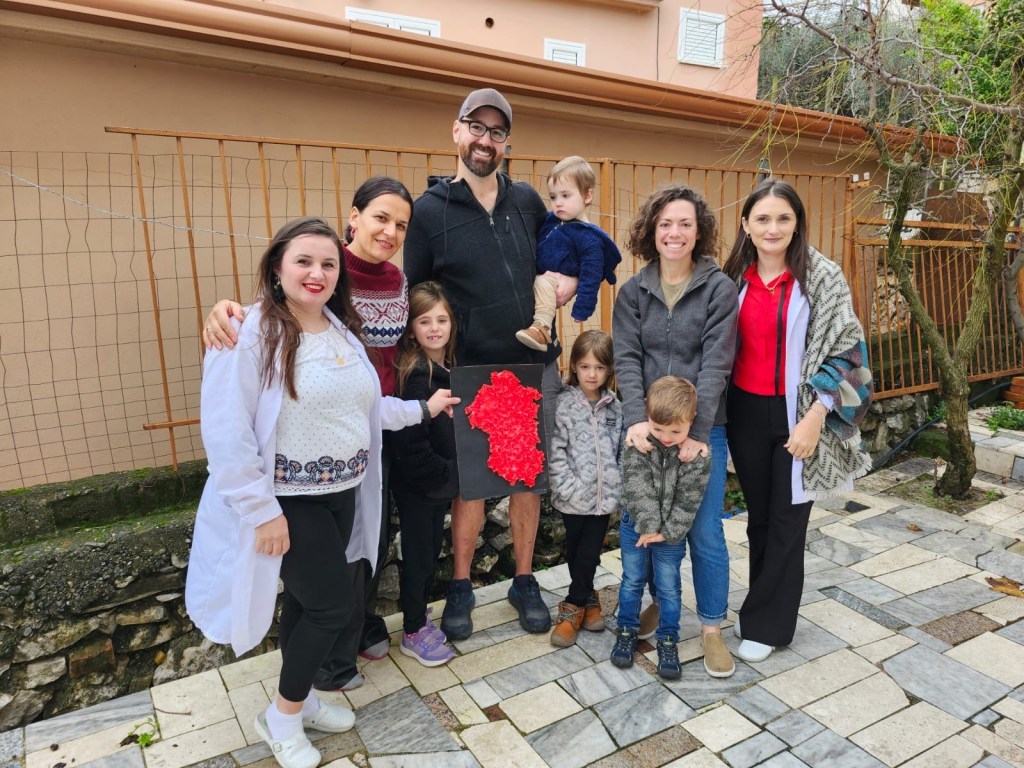
Sickness definitely affected our volunteering goals, but so did things out of our control like multiple losses of electricity. In the end, we were able to learn about the Joshua Center’s important work and the Roma people they serve. Nic set them up with a good wood supply for their wood stove and built some much-needed shelving for storage. We were able to purchase some items they needed as well. So although we wish we could have done a lot more, we feel thankful to have had a chance to serve alongside these kind people.
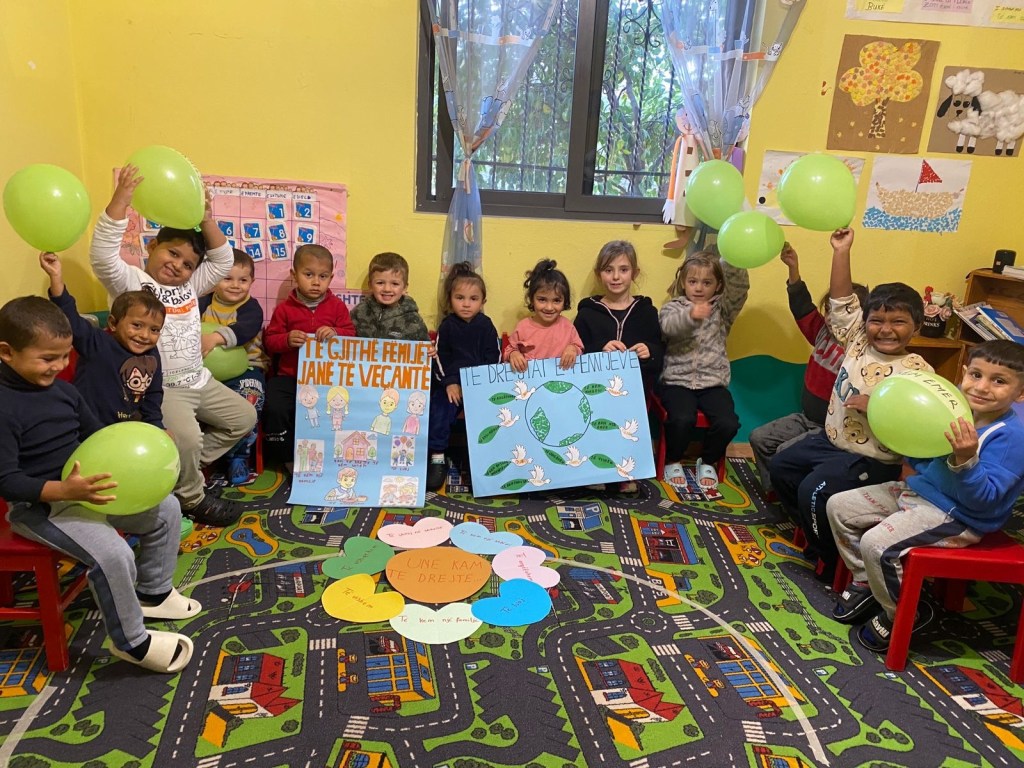
Storage shelvingChristmas craft with Roma momsFun with the kids
And now we have left Lezhë and headed south to tour the country over the next two weeks.
We stayed a quick night in Elbasan to break up the drive to our next longer destination. We arrived with enough daylight to head out on foot and explore briefly. Structures were first built in this site over 2000 years ago, as it was an important defensive post along the Roman Via Egnatia, an important route linking present-day Durrës, Albania, to eastern places like Thessaloniki and Constantinople. The castle walls we saw were only around 600 years old, though. We wandered the narrow cobbled streets for a few minutes before finding frozen pizza in a grocery store (not a guarantee in even bigger Albanian grocery stores). We saw no other foreigners and felt a little famous. Ha! Nic said we’d certainly end up in the paper.
Elbasan Castle
Today’s drive brought us farther south to Korçë. We spent the morning winding through the Albanian countryside. If you look just slightly above where you would normally look, things are beautiful, the hills undulating endlessly and dramatically across the landscape, snowy mountain towering in the background. But if you look down at the ground, or the shore of the river, or just too closely at anything, you see trash and neglect. So look back up to see terraced fields on the hills, smoke rising from chimneys on a cool morning, old men in the middle of nowhere waiting for their ride, endless little fruit markets and farm stands.
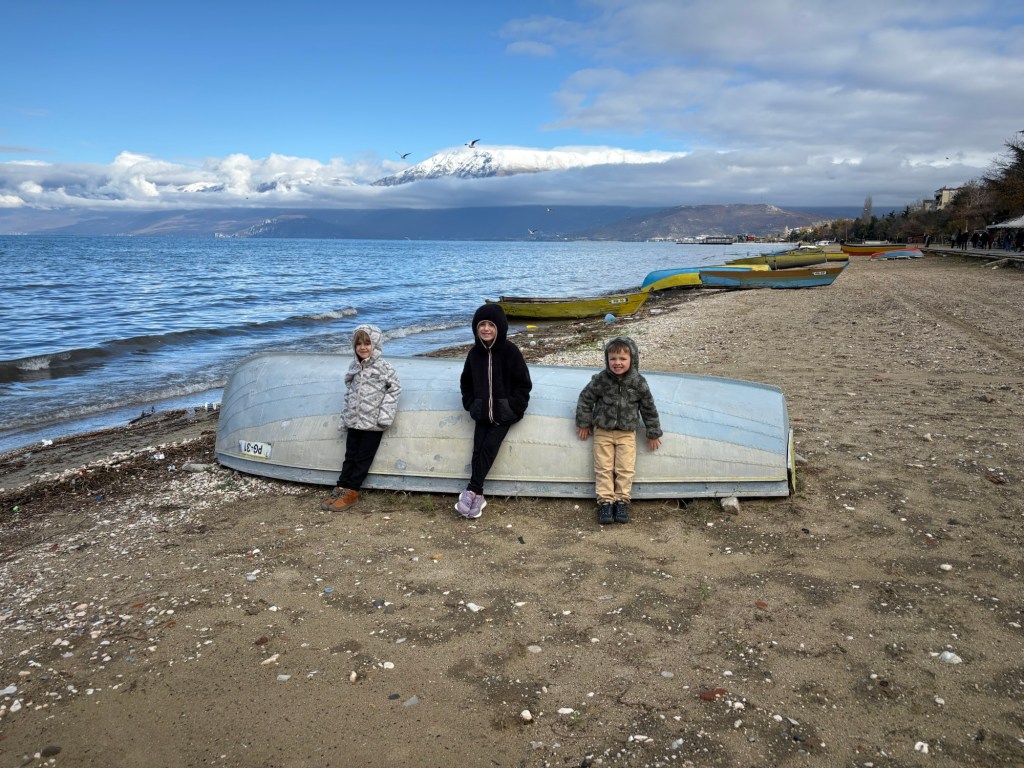
Lin on Lake Ohrid
Our route brought us to Lake Ohrid, a big body of water bordered by Albania and North Macedonia. We found lunch in Pogradec (no other foreigners in sight) and made our way to Korçë.
Looking east to North Macedonia
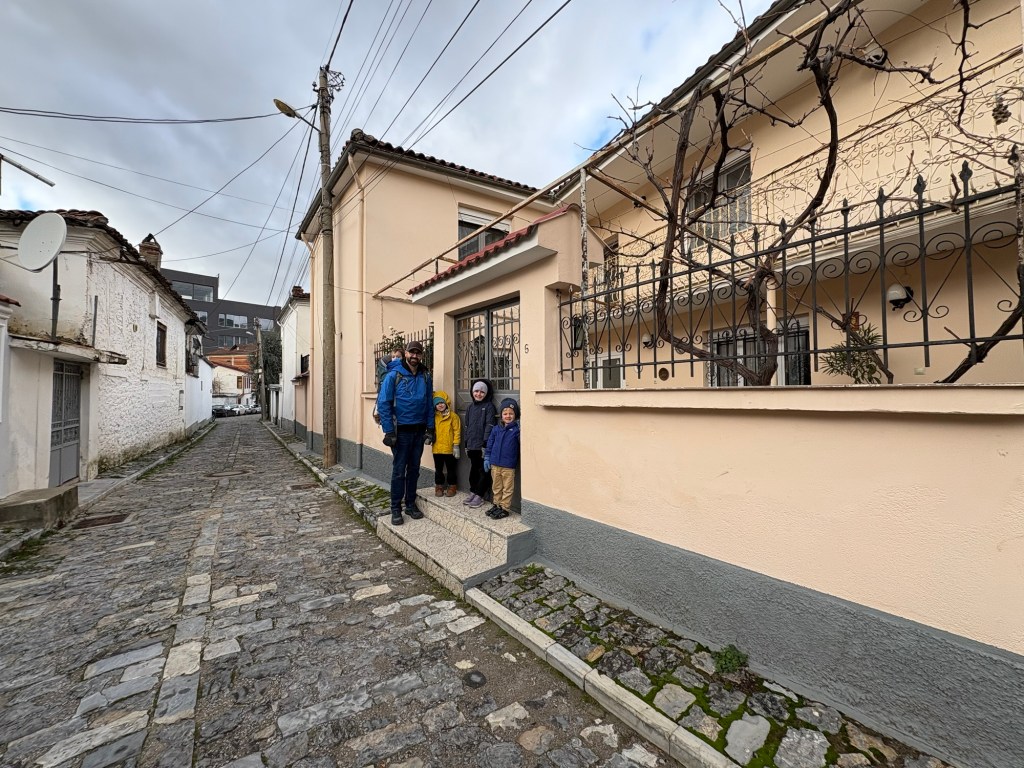
We found our Airbnb easily, but maneuvering our rental minivan into the tiny parking area was tricky. We’re staying in a rather claustrophobic warren of narrow cobblestone streets and hope to not move the car much while we’re here. We were met by our Albanian grandmother hostess who doesn’t speak a lick of English and jabbered in enthusiastic delight when she laid eyes on our kids. She went home and came back with treats for them and wouldn’t stop talking about Jude’s bare feet in the cold house. We had a hard time figuring out her instructions, but it all worked out okay.
The atmosphere of Korçë feels different, and it’s more than just the crisp mountain air. We are excited to explore more tomorrow!
Katedralja “Ngjallja e Krishtit” (Resurrection of Christ Cathedral)
We had looked forward to this weekend as a chance to do some sightseeing and take a break from our volunteering.
We started by driving up to Lezhë Castle, a crumbling ruin sitting atop the town of Lezhë. Parts of this castle are as old as 3rd-4th century BC! It’s amazing to consider how long people have settled in this part of the world. Unfortunately, we only got to wander around for a short time before a lightning storm chased us back to the car, with soaked sweatshirts. That might not sound like a big deal, but it meant our main warm layers were out of commission for about 36 hours. We had to pay a small fee for entry, which we paid in euros due to having no small Albanian lek change at the moment. You can pay for just about anything here in either currency, and I think they’ll take US currency as well in plenty of places. The attendant gave us change in lek and euros, and I’m not sure I’ve ever received change in two currencies before.
The storm approachesLooking down at LezhëCountryside surrounding Lezhë
We had some small wins as well as we found a nearby restaurant and managed to order takeout. Perhaps this doesn’t seem like a triumph, but something about walking into a restaurant is very intimidating to me.
We also found a great grocery store with a big, empty parking lot. The best grocery store we had found before this was downtown and required thirty minutes of frustrating circling to find iffy parking.
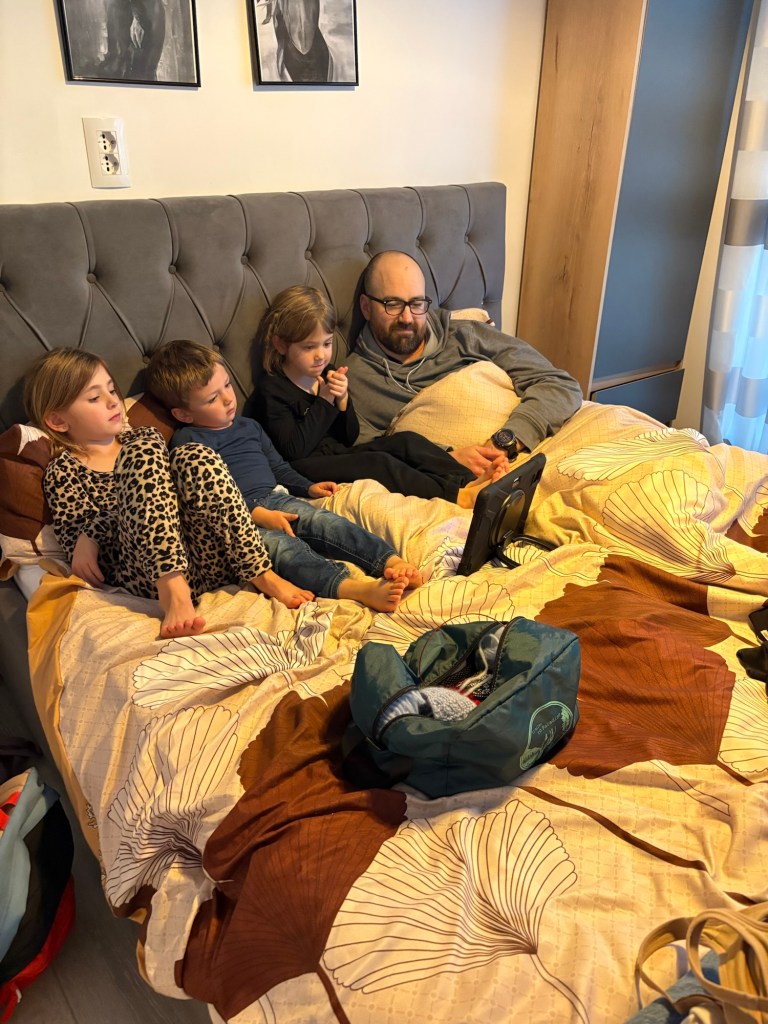
Rainy day movie time
But everything went south when I started feeling sick to my stomach. I suspect food poisoning, or a bug from the water. We’ve filtered 100% of our drinking water here, but I have used the water for brushing my teeth and rinsing my toothbrush. In any case, I have been out of commission completely for 24 hours and even though it’s been 16 hours since I last vomited, I feel completely drained. Here’s to hoping for a better day tomorrow!
We have settled into a bit of a routine in Lezhë. We are volunteering this week and next at Qendra Jozue, or Joshua Center. We got into contact with the director, Norma, a bit randomly while searching for volunteering opportunities that we could do as a family. We have received a warm and kind welcome, even though we feel rather useless.
Norma is a Brazilian woman who came here to do aid work during the area’s time of ethnic conflict in the early 1990s. Instead of going home, she stayed to help. She founded Qendra Jozue with little help, and the center’s mission is to serve the extremely marginalized and poor Roma children and their families.
Qendra Jozue’s front door
In a country that can be called Second World at best with a relatively low standard of living for all but a few, the Roma people are the absolute bottom of society. They are discriminated against and viewed as dirty and undesirable. We have learned so much about their difficulties in our short time volunteering, and it’s heart-breaking to hear about how they live.
Girls get married (usually arranged, and sometimes even “stolen” and raped into marriage) as young as twelve and begin having babies immediately. A woman may have had more than four children by the time she turns twenty, and the hard work of childbearing shows as these mothers appear much older than their age. I had an opportunity to meet a group of mothers today, and all of them had at least four children, some as many as nine. It’s nice to be with a group of people who doesn’t look twice at our family size, but not under their desperate circumstances. When childbearing weighs too heavy these women will turn to frequent and repeated abortions, a service provided free of charge by the government (a communist-era norm that continues). The mothers beg or clean around town to earn a meager income, rarely enough to put much food on the table. Their husbands drink coffee, smoke, and struggle with alcohol problems. Domestic violence is common. The Albanian government has provided very basic housing for the Roma people, but their large family size and close generations mean that many people share extremely cramped living quarters, like a dozen people in a small shipping container, for example.
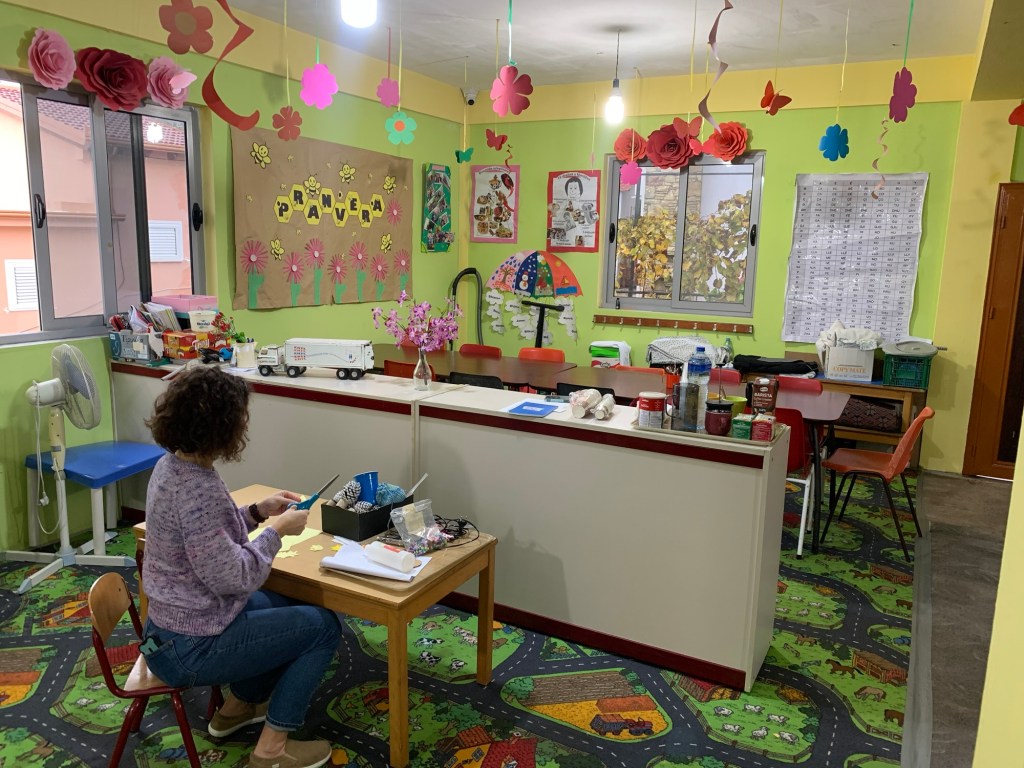
Qendra Jozue offers a preschool program five days a week. The kids learn pre-literacy skills and are given a very basic morning meal. They brush teeth too, a practice it seems they do not learn at home. Every mouth shows signs of decay, even among the very young. In the afternoon, the center provides an after-school program three days a week for older kids. They receive a hot meal and help with homework. The generation of kids we have met is the first of the local Romas to attend school, and their mothers are all illiterate. The center also teaches Bible stories to these kids who are predominantly Muslim. Roma mothers meet weekly at the center as well for coffee, chatting, and a Bible story.
The director of the center fundraises in the United States every two years, and that’s the sole source of their funding. The government provides no help, but makes sure to collect taxes. The center provides what I assume is a very low wage for the director and three other women. They run a very tight ship, and it looks like they stretch each dollar they receive about as far as humanly possible. The center holds a long lease in a decent building, but nothing is the entire place could be called new or nice. The toys, puzzles, school supplies, etc. are all extremely basic and very heavily used.
One of the classrooms looking better here than in reality
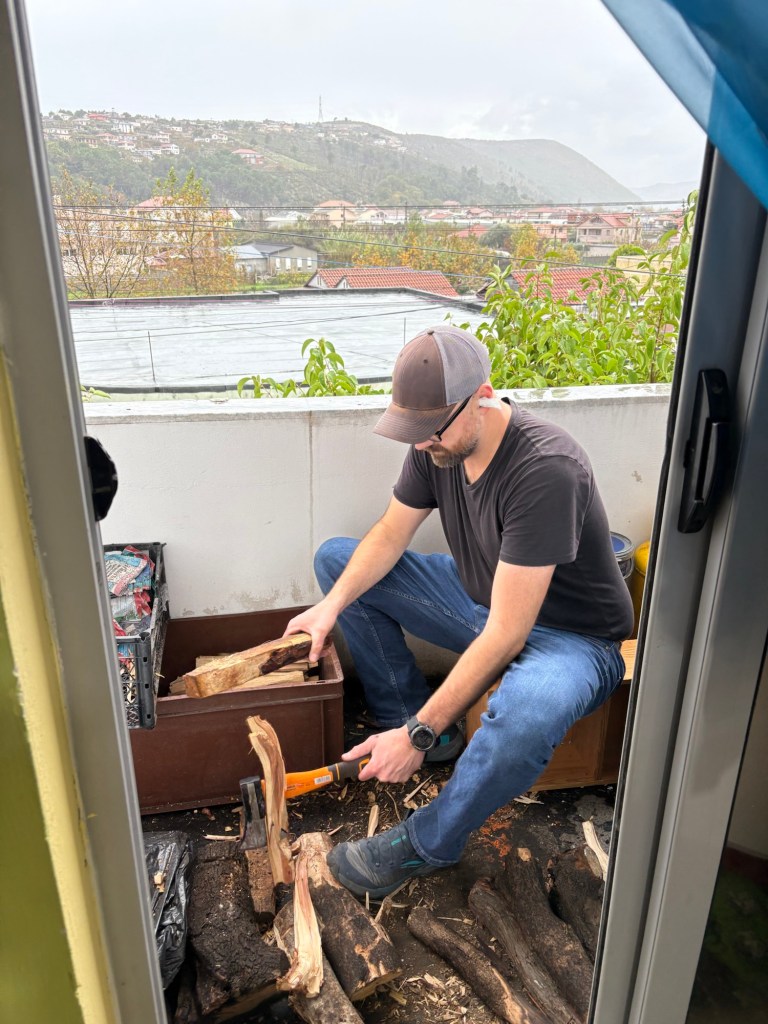
How have we fit into all this? We have primarily spent time with the kids, playing with them, hugging them, helping with homework, and just generally doing our best to show them love. Our kids have been able to tag along in the classrooms. Jude has been difficult to corral, and with news of some chickenpox cases at the school, we are switching off and keeping him home now. I have chopped vegetables and done dishes and got to help with the weekly mothers’ meeting and a little Christmas craft. Nic has split wood for their wood stove and is working on some shelving for storage. We have tried to listen and learn, but only the director speaks English. We expected the older kids to have more substantial English skills, but only a few can communicate with us.
Splitting wood
It’s humbling to eat with the group and to know that what our kids consider morning snack time is perhaps the only nutrition those kids will get for the day. Some hot milk and a small portion of rice with buttermilk will have to fill their little bellies for an entire day. We find ourselves watching our kids carefully, hoping that they will graciously eat every single bite put in front of them. The afternoon hot meal is something simple like potato soup with salad or pasta with tiny pieces of hot dog. The food has been tasty, but it doesn’t provide many calories. And in general, even what’s available in grocery stores is mostly carbs with very minimal protein and fat.
Laila and Quinn can understand the poverty at least a little bit, but I don’t think Morgan gets it at all. And it’s hard to understand the extent of the poverty when the kids we are interacting with seem more or less okay. We’ve seen a few toddlers and babies who are just way too chill to be receiving the nourishment they need, but the older kids have enough energy to play and get in trouble. Their clothes are shabby and out of style, but they are clean and cared for.
Meanwhile, the whole area oozes neglect. It’s hard to look past the piles of trash on the beach and everywhere in the street. The stray dogs and cats we see everywhere flinch if you get too close and look disgustingly diseased. Some buildings appear sturdy and clean, but many houses appear way too dilapidated to be livable. The area has received some strong storms and heavy rain since we’ve arrived, and the poor infrastructure has limped to keep up with drainage.
Beach trash
Albania possesses much natural beauty according to the guidebooks, but we have yet to see much of it. We know we are learning some important things here, but we’d like to see some beauty too!
That gibberish above is “hello and thank you.” Perhaps the pronunciation isn’t terribly difficult, but how is one to remember a long string of syllables that bears no resemblance to English? It’s Albanian, everyone, and we know about five words.
We made it to Albania two days ago. We experienced our first flight delay of the trip on our way here. Ninety minutes doesn’t sound like much, but when you’re entertaining four kids in a crowded airport, it feels like plenty. But after a short hop across the Adriatic Sea, we landed in Albania, collected our rental car (an automatic Honda Odyssey – a nice surprise!), and drove to Shengjin. We have mentally prepared ourselves for crazy driving here, but the highways in this part of the country are totally fine. People interpret the speed limit generously and drive aggressively – we can do the same.
Our Airbnb for two weeks is right on the beach, which is pretty deserted at this time of the year. The kids have enjoyed beach combing and getting super sandy. We can wash those super sandy clothes, but getting them dry is a different situation. Without a dryer, you have to allow at least 24 hours for clothes to dry. And we have limited clothing, so this has been tricky.
Our view
Albanian beaches have been gaining popularity in recent years. I’m sure the water is lovely during the summer. But when the beach is empty, it’s hard to look past all the trash. And in general, most things we have seen so far in Albania look rather shabby. Understandably, this post-communist country has a host of struggles it’s working through as it aims to join the EU and improve its status.
In other news, the last woman standing (Laila) has finally succumbed to the flu. The other kids are basically healthy again, and Nic and I continue to deal with drainage and congestion.
We miss the comforts of home as we continue to feel like so many things are just difficult. It’s time-consuming and hard to find food that works for us, and preparing what we do find is annoying in a small, ill-equipped kitchen. Our lodging options have all been tiny compared to our home, and it’s hard to be in such tight quarters with four kids. It’s not easy to find familiar cold remedies. Our beds for the next two weeks are awful. The mosquitoes are just as aggressive as the drivers. The list goes on…
We certainly wonder at times if this was a good idea. But what is there to do other than keep on doing our best with each day and trust God to care for us all? We continue seeing what we can and doing school as time allows, and for the next two weeks we will be volunteering at a community center that works with the local Gypsy population.
We purchased international eSIMs for our travels, which has worked very well. We have plenty of data, which is helping us do everything we need to.
If you have tried texting us and haven’t heard back, you probably need to make a quick change next time you text. We both have iMessage, so you can make this change if you have an iPhone.
First, make sure you have our email addresses in our contact info in your phone (nicandkatiehendrychs@gmail.com for Katie and nicholas.hendrychs@icloud.com for Nic). Side note: don’t try to email Nic at that address. Go to Messages, and start a new message. When you select my name, you should have a drop-down option that allows you to select my email instead of my phone number. Using my email should send a blue message that shows you that you’re using iMessage. Text me, and I will respond if it worked!
If you have an Android phone, you can also reach us both on WhatsApp.
We miss our people and would love to hear from you about all the normal things you’d text us about if we were back home. Keep in mind that we are six hours ahead of Eastern Time right now, so if you text during your afternoon or evening, we won’t get back to you until the next day.
We departed Copenhagen in the dark, way too early. We generously gave the “happiest people on earth” one last chance to roll their eyes at our brood, and roll their eyes they did.
We’re on the wall in Copenhagen Airport!
Jude screamed minimally on the flight, which brings his odds to about 50/50 for pleasant flights. We crossed the Alps in sunshine and smooth skies. Several Italians stood in the aisle and chatted with their friends the entire flight. They spoke with faces close, voices cheerful and warm. We saw smiles, and people made neutral to friendly eye contact. Things already felt so different from Copenhagen.
After riding the crazy rollercoaster monorail Marconi Express into town, we found our apartment easily.
Some initial impressions of Bologna: noisy, lots of trash everywhere, warm colors on every wall, free smoking via secondhand smoke, lots of ethnic diversity, so much going on! But with all the craziness, we felt perfectly safe and more welcome than in Copenhagen. We have gotten plenty of double-takes and audible gasps of “Quattro!” We’ve also been congratulated on our beautiful children. A street musician took a moment to exclaim, “Mama mia – uno, due, tre, quattro!” Another perk: prices are universally lower here. Our grocery bills and lodging are about half the price as in Copenhagen. Espresso and four enormous bakery treats were cheaper than at home. Haircuts and manicures and all sorts of things are cheaper than at home as well.
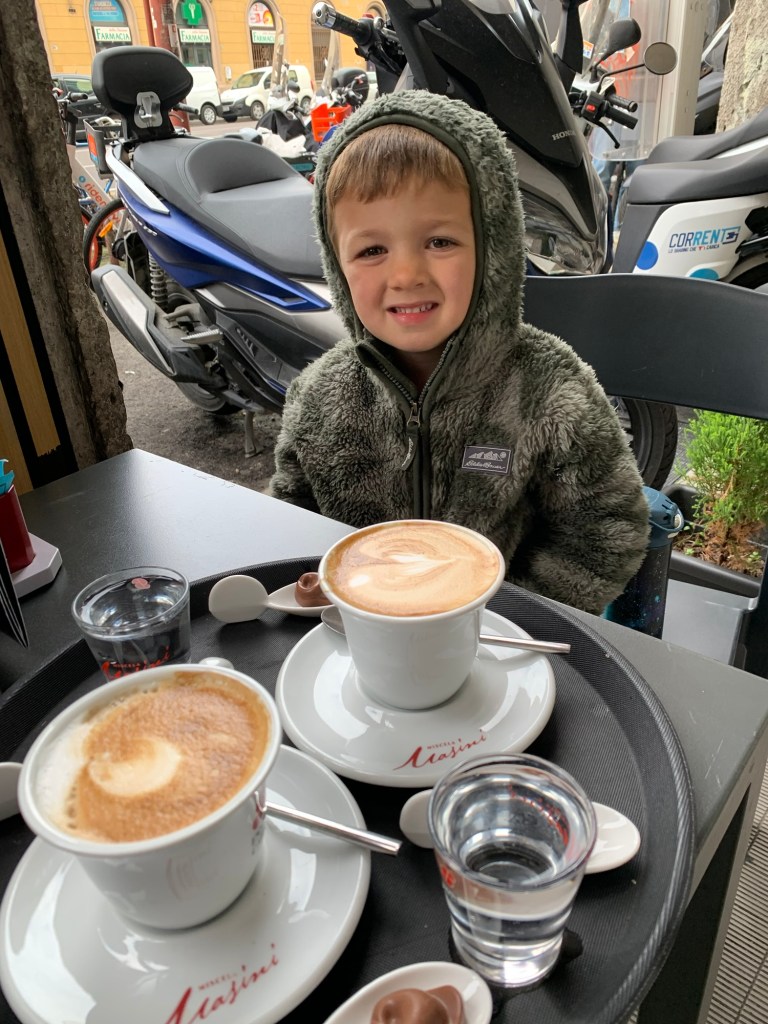
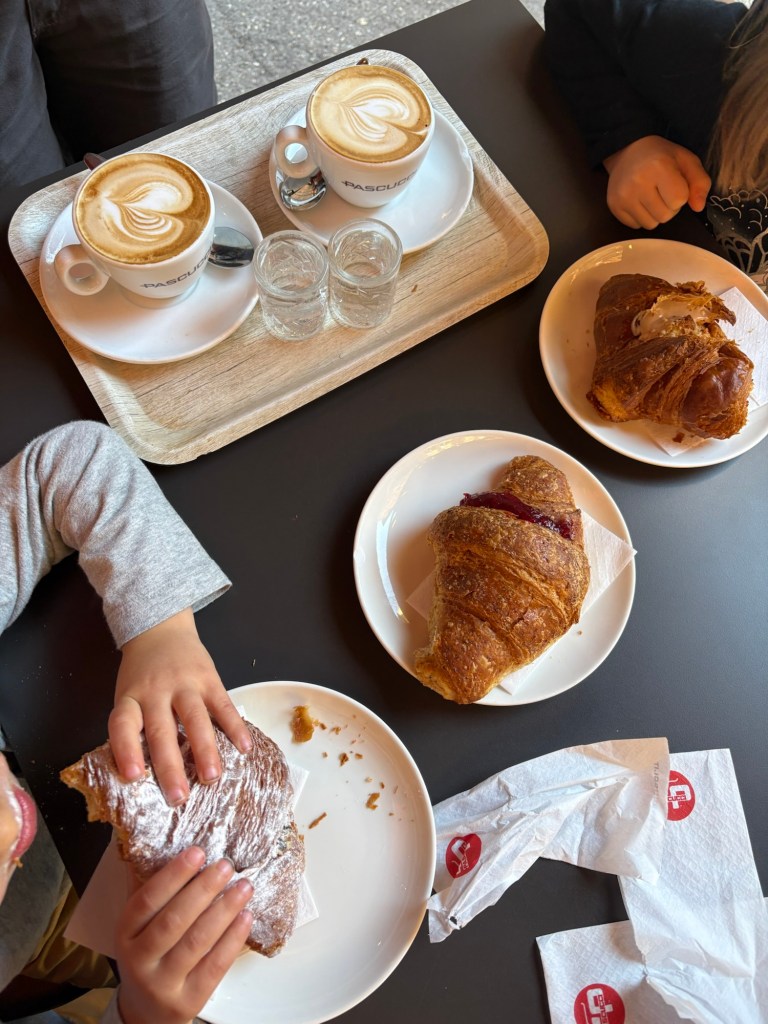
While exploring a bit we stopped first at a bar, which is where you get coffee as well as various other food and drinks. The barista asked me the most delightful question that should be asked with every coffee order (and that I did not my understand): “Would you like some chocolates with that?” Yes, of course, and they were delightful!
Due cappuccini, per favore!
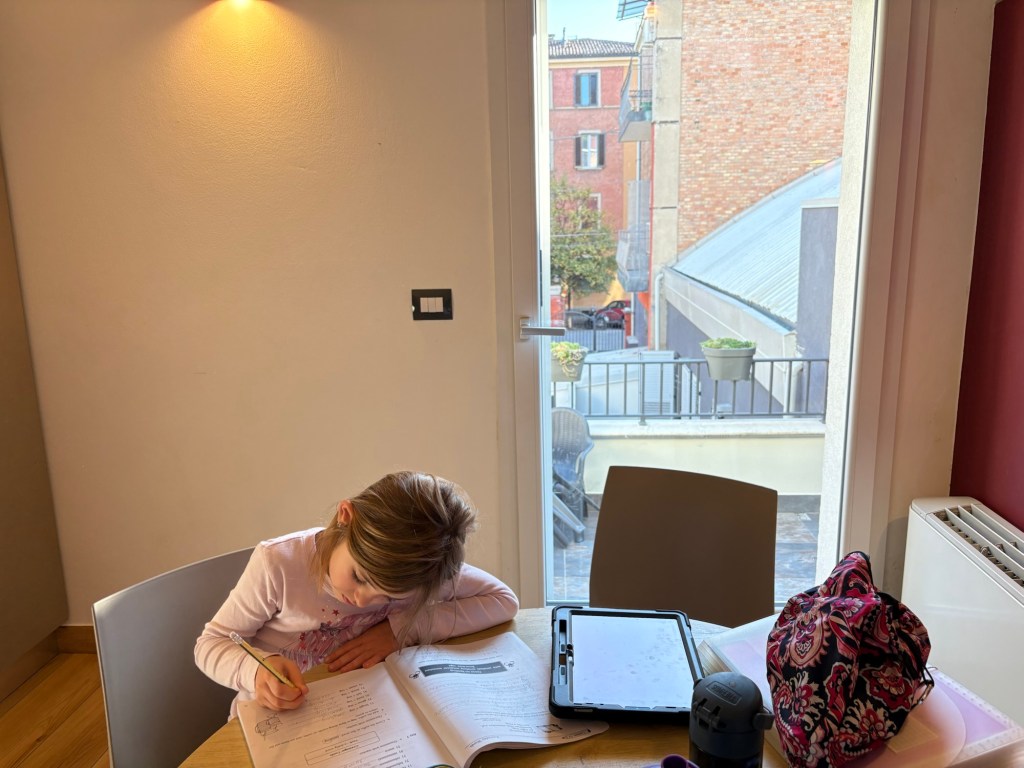
Sickness has continued to bog us down, and I’m pretty convinced it’s the flu. Day two in Bologna was a day for rest and school. I’m having a hard time making school happen, and it’s easy to see that the lack in continuity is not helpful to the girls. We’ve had several weeks of straight Mondays!
Homeschool on the road
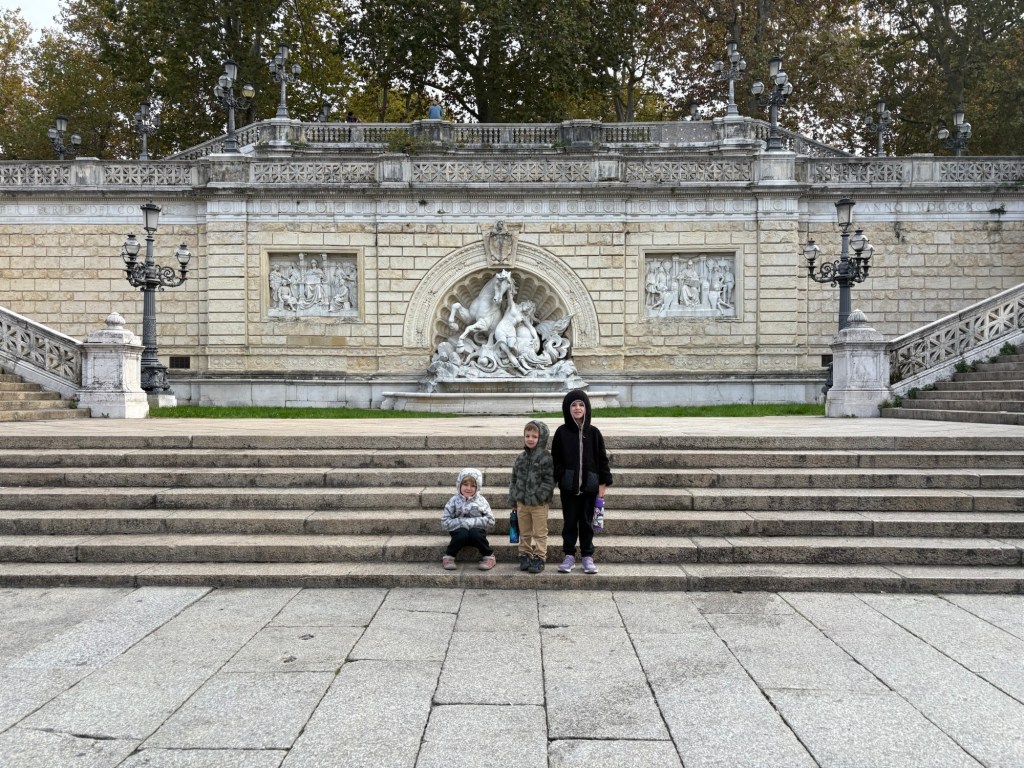
We made our way into the historic center of Bologna today. The kids walked 10,000 steps. We are surrounded by so much history, and because of the pace of our trip, we’ve done a dismal job at understanding each location on even a basic level. The kids are doing some research for social studies, but that just barely scratches the surface. There is always next time!
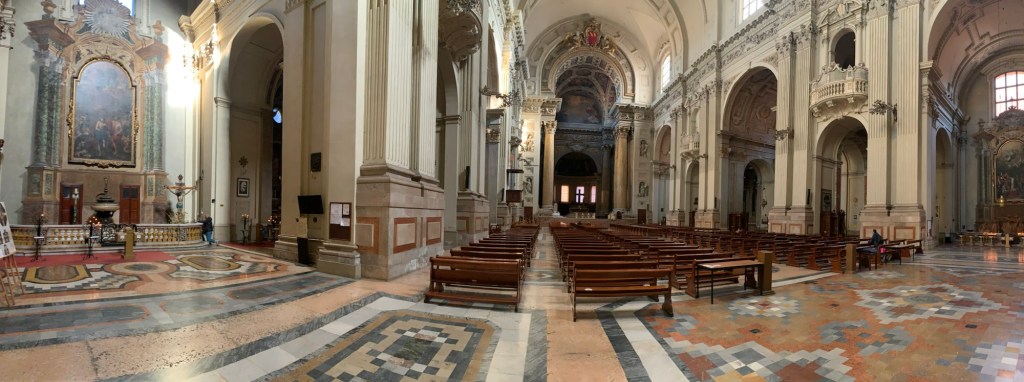
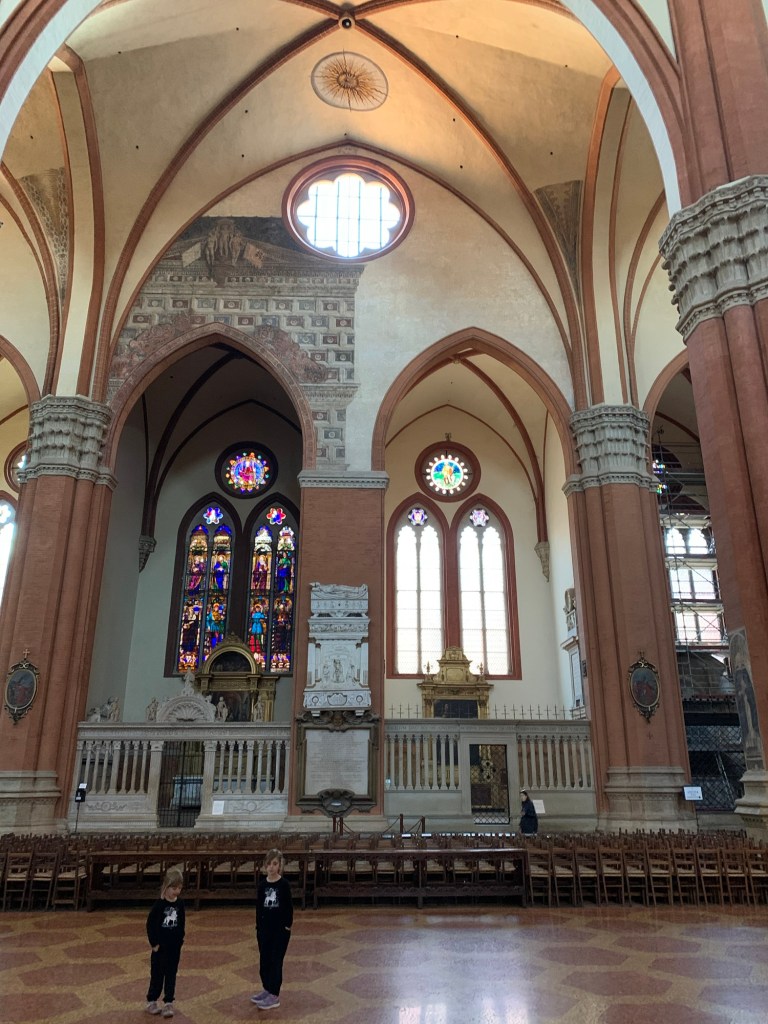
Cattedrale Metropolitana di San PietroImpossibly high ceilings of Basilica di San Petronio
The awe-inspiring cathedrals provided welcome respite from the sounds and smells of the street. It’s hard to tell what exactly the kids think of what they’re seeing, but I think they enjoy the churches just as much as we do.
Enjoying the food scene of Bologna is not the easiest with our crew, but we’ve had pizza, focaccia, bakery treats, and some delicious pasta. I read that kids are welcome at restaurants, but we have done fine with quicker options. Laila has enjoyed everything. Morgan is fairly adventurous with eating, but he’s currently stuck in a power grab mood where he throws a fit one meal a day for all sorts of reasons. Quinn is our pickiest eater, and she’s not as big of a fan of the new and unexpected flavors. Jude’s favorite word is “bar,” typically signifying a firm and forceful demand for a granola bar or other snack, to be followed almost immediately by screaming if demands are not met.
Tortelloni
Fillings the kids chose: berry jam, ricotta and chocolate chips, white chocolate, and hazelnut butter






























 Are you having fun with me today?